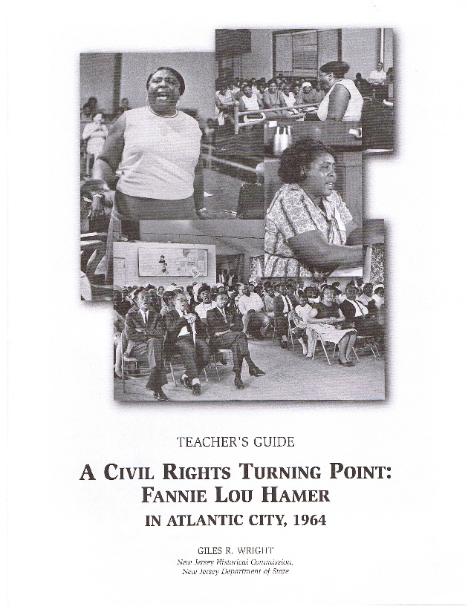
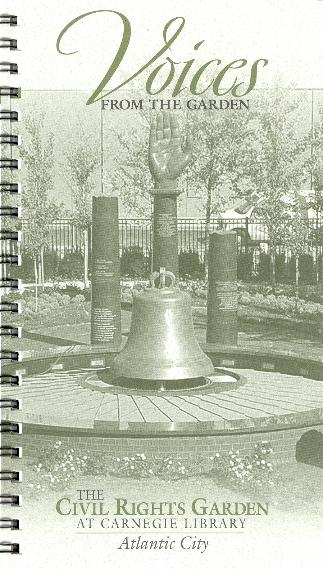
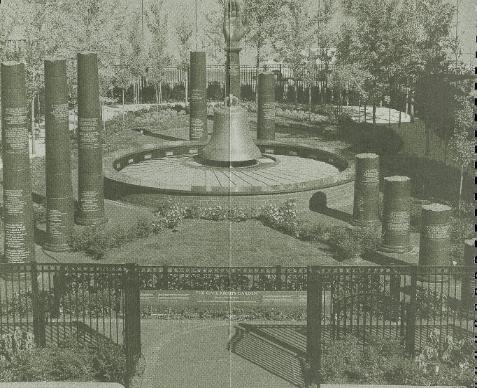
Fannie Lou Hamer Curriculum Grades K-12 State of New Jersey There are eleven columns at The Civil Rights Garden in Atlantic City, New Jersey. Mrs. Fannie Lou Hamer shares column ten with Dr. Martin Luther King, Jr. and Rabbi Joachim Prinz.
It reads “All this on account we want to register, to become first-class citizens, and if the Freedom Democratic Party is not seated now, I question America. Is this America, the land of the free and the home of the brave where we have to sleep with our telephones off the hooks because we want to live as decent human beings, in America?”
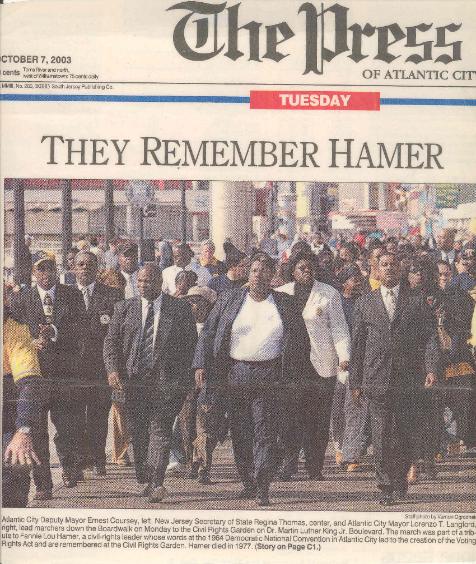
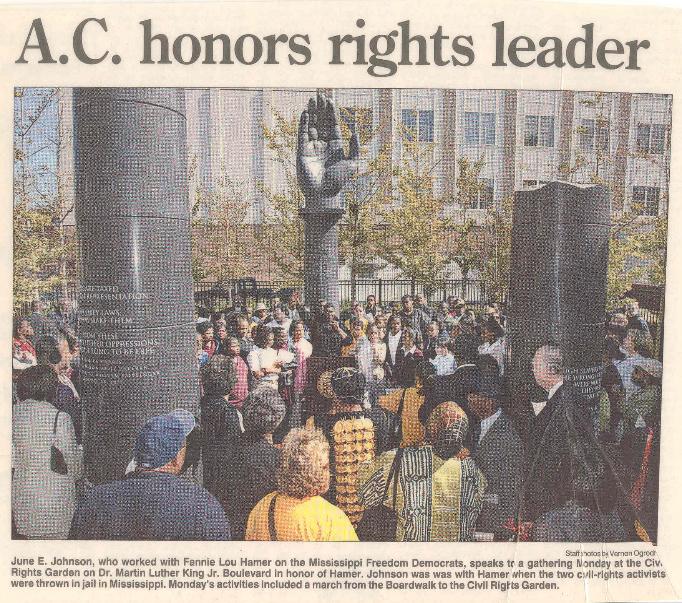
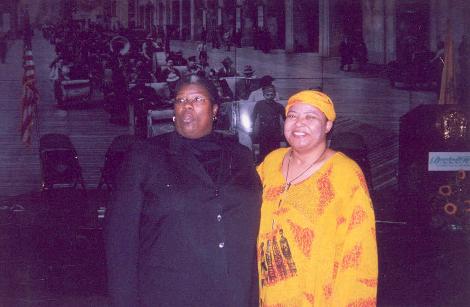
Atlantic City, New Jersey, October 2003
Mississippi Governor Haley Barbour Signs Bill Allowing Civil Rights Curriculum in Schools
Mississippi has positioned itself to become a pioneer in offering civil rights history lessons from kindergarten through high school.
Gov. Haley Barbour announced March 21, 2006 that he had signed a bill that authorizes the state’s public school districts to make civil rights and human rights a part of the curriculum in all grades.
Under the bill, which becomes law July 1, a commission would be appointed to help districts develop the curriculum and find resources to offset the costs. Implementation would be left to individual school districts.
Susan Glisson spearheaded the bill. As executive director of the Winter Institute for Racial Reconciliation at the University of Mississippi, Glisson said it was modeled after legislation passed in several states, including Mississippi, that mandated that the Holocaust be taught in public schools.
She further stated, according to the associated press, that the institute had been unable to identify any other state that has set up a similar program devoted solely to civil rights history. The idea for the bill came from Glisson’s conversations with history teachers during civil rights workshops sponsored by the institute.
Currently, textbooks in the state refer to the civil rights movement but schools usually don’t devote an entire course to the subject.
“The reality is in the way that the civil rights movement normally gets taught, we erroneously communicate to the students that one person made it all happen,” Glisson said. “So much attention gets placed on Martin Luther King, for instance, that we do not see the contributions made by grass-roots people, some of whose names we may never know.”
“The message that gets communicated is that we have to have a savior to make our communities better when the reality of civil rights is that we have the power to do it ourselves.”
Governor Barbour said he thinks the broader the curricula and history are, the better it is for the students. Additionally, Barbour stated the more the students can learn the better citizens they can become.
According to the Associated Press, House Education Chairman Cecil Brown, D-Jackson, said it is important that young people fully grasp the sacrifices people made for equality.
Brown – who witnessed the rioting that occurred when the University of Mississippi was integrated in 1962 – said young people in the state weren’t around “to see what it was like to see Klansmen marching, to have Jewish people and black people bombed. It was a scary time. Certainly for African-Americans, they’ve lived in two worlds.”
But there are other aspects of civil rights – beyond black-and-white issues – that will be taught in at least one of the school districts.
Pat Cooper, education superintendent for McComb Public Schools, said his district’s curriculum also will include struggles in other states, such as “the sugarcane cutters in Louisiana and the vegetable pickers in California.”
Cooper’s district already is working with the Washington-based consultants, Teaching for Change, to develop a curriculum that could be implemented next school year.
Cooper said teaching civil rights is just the next step in what has been a nine-year effort to reunite his community. He said when he became superintendent in 1997, most white students were in parochial or private schools.
“There was a lot of misinformation and stereotypical thoughts. We began several years ago trying to figure out a way to communicate. We’re trying to create a whole new generation of citizens who think very differently about this issue,” Cooper said.
McComb’s 3,200-student district is 77 percent black and 23 percent white. Cooper said nine years ago, it was about 15 percent white.
The bill is Senate Bill 2718.
Disclaimer: THE ROAR FOUNDATION, INC. provides information on this web site for educational/informational and networking purposes only! Use of any copyrighted materials must be approved by its owner. ROAR claims no responsibility for misuse of information obtained on this web site.
| (c) copyrighted THE ROAR FOUNDATION, INC. | April 2006 |
| Last Modified | October 2010 |